

A supplier can complete a sale and still face a cash shortage when the invoice is due several weeks later. Early payment for suppliers in India addresses this timing gap by helping eligible businesses access value from approved receivables before the buyer’s original due date.
Cash that would otherwise remain locked in invoices can return to operations sooner. Businesses can use that liquidity for raw materials, wages, logistics, inventory replenishment, or new orders. Instead of waiting for one sales cycle to close before starting the next, the enterprise can keep its operating cycle moving while customer settlement continues as agreed.
Explore our guide on Trade Finance Solutions for SMEs in India: Smarter Ways to Fund Growth to understand how flexible trade finance can support working capital and business growth.
How does early payment for suppliers in india improve working capital?
It improves liquidity by shortening the time between completing a sale and having usable cash available. In a structured buyer-led arrangement, an approved invoice may be financed by a bank or financial institution, while the buyer settles with that financier on the original due date.
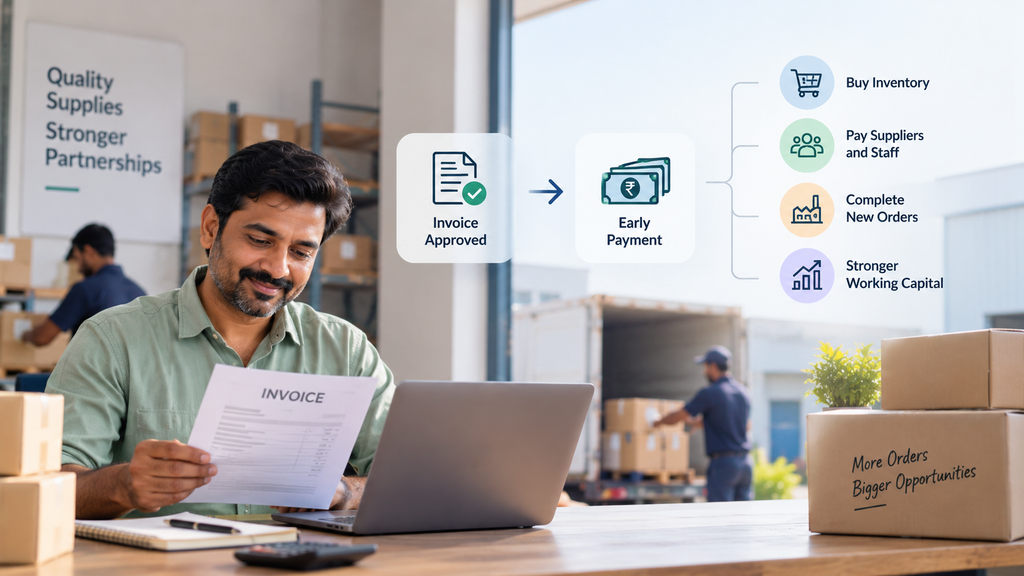
This can strengthen the working capital cycle in four ways:
- Less cash tied up: Outstanding receivables become usable liquidity sooner.
- Smoother operations: Available money can support inventory, payroll, logistics, and production.
- Better order readiness: Businesses can prepare for new demand before older invoices mature.
- Clearer planning: Predictable collections can make short-term planning easier.
Where does invoice liquidity make the biggest difference?
The value of invoice liquidity becomes clearer when a business repeatedly sells on credit.
| Business Situation | Without Acceleration | With Structured Finance |
| Approved invoice | Cash waits until due date | Eligible receivable may be financed |
| New order arrives | Existing cash may be stretched | Released cash can support execution |
| Operating bills fall due | Timing pressure increases | Liquidity becomes available sooner |
On TReDS-type arrangements, accepted invoices can be financed while the buyer continues to settle on the original due date. The commercial cycle does not necessarily need to change.
For businesses managing recurring receivable gaps, early payment for suppliers in India can help convert eligible invoices into usable cash sooner without disrupting the agreed buyer payment cycle.
For businesses involved in international trade, explore How the LC Discounting Process Works for Importers and Exporters to understand how LC-backed receivables can support early access to funds.
Buyer-Led Finance Strengthen the Supply Network
Buyer-led finance can help reduce liquidity pressure across the trading relationship. When vendors have access to cash at the right time, they are better placed to maintain inventory, production, and delivery schedules.
For the seller, stronger cash flow stability can also reduce dependence on emergency short-term borrowing. Actual benefits depend on invoice eligibility, buyer approval, documentation, pricing, and financier terms.
Growmax Fintech supports businesses through supply-chain finance, invoice discounting, working-capital solutions, trade-credit solutions, and TReDS onboarding assistance.
To understand how the Trade Receivables Discounting System (TReDS) works for MSME receivables financing, explore the Reserve Bank of India’s detailed TReDS FAQ guide
FAQs
1. Does accelerated settlement change the buyer’s due date?
Not necessarily. Structured receivables finance can allow the buyer to keep the agreed settlement date.
2. Is every approved invoice eligible?
No. Eligibility depends on the transaction, documentation, buyer profile, platform rules, and financing terms.