

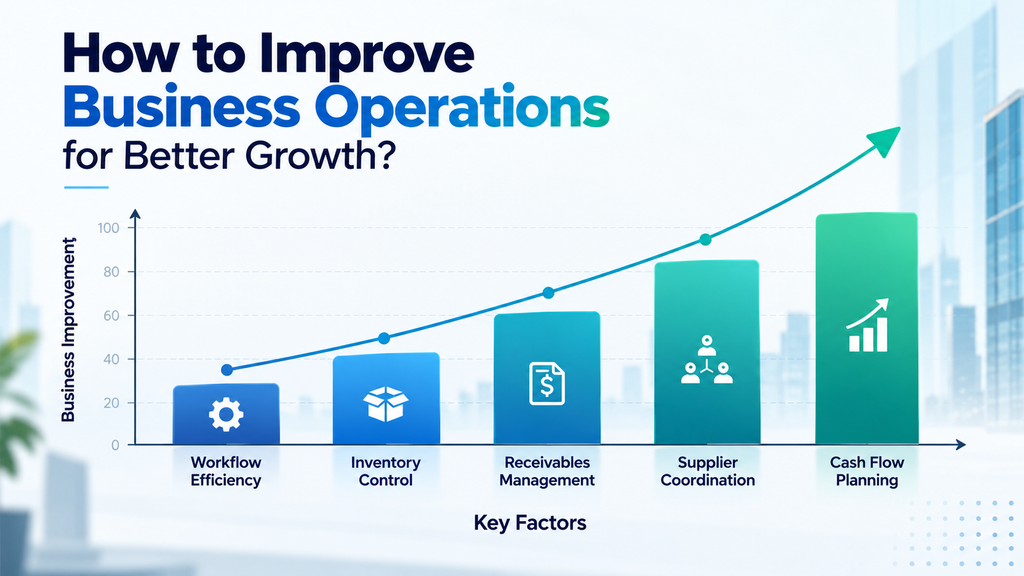
Growth becomes harder when everyday work is slowed by delayed approvals, excess inventory, repeated manual tasks, or cash tied up in receivables. how to improve business operations begins with identifying where time, money, and effort are being lost, then fixing the process before adding more resources.
A growing company should review how orders move from enquiry to delivery, how inventory is replenished, and how customer payments are collected.
The goal is not simply to work faster. It is to build a smoother operating cycle that can handle more customers, larger orders, and changing demand without creating unnecessary cost or cash-flow pressure.
For practical ways to strengthen cash flow and manage daily financial requirements, explore our guide on Working Capital Strategies for Growing MSME Businesses.
How to Improve Business Operations Without Adding Complexity?
Start with the activities that directly affect customers, delivery, and cash. Instead of changing everything at once, identify the few points creating the biggest delays.
A practical review should check:
- Slow approvals or hand-offs
- Repeated manual tasks
- Errors and avoidable rework
- Excess or insufficient inventory
- Customer collections versus supplier payment dates
Standardising repeatable activities can make responsibilities clearer and reduce unnecessary variation. Inventory should also be compared with sales patterns and purchasing schedules so cash is not locked in excess stock or sales are lost because stock is unavailable.
How Can Better Financial Planning Support Operations?
Better financial planning also plays an important role in how to improve business operations, especially when customer payments are delayed while inventory, salaries, and supplier commitments still need to be managed.
working capital solutions in India may support eligible short-term requirements. Invoice Discounting can help qualifying B2B receivables convert into earlier liquidity, while supply chain finance can support buyer-supplier payment cycles.
Growmax Fintech provides invoice financing, working-capital, supply-chain finance, and trade-finance solutions for SMEs and MSMEs across India, subject to eligibility and applicable terms.
What Should Growing Companies Measure?
Operational improvements should be tracked through a few practical indicators:
- Turnaround time – Are tasks and approvals moving faster?
- Inventory movement – Is stock being used efficiently?
- Delayed receivables – Are customer payments improving?
- Supplier-payment timing – Are obligations being managed without pressure?
- Recurring rework – Are repeated errors reducing?
The goal is to confirm that process changes are actually improving the operating cycle, not just creating more activity.
For growing enterprises, the strongest approach is to remove process bottlenecks first, monitor results, and use suitable financial solutions only for a clearly identified cash-flow requirement.Businesses involved in domestic or international transactions can also explore trade finance in India for eligible trade-related requirements.