
Managing cash flow is one of the biggest challenges for small and medium exporters and importers in India. When payments get stuck for 60–90 days, even profitable businesses feel the strain. This is where export and import bills discounting becomes a powerful tool. It allows SMEs to convert trade bills into immediate cash rather than waiting for overseas or domestic buyers to pay. For Indian businesses that rely on timely working capital to purchase raw materials, pay staff, or book new orders, understanding export and import bills discounting is no longer optional; it is a core part of smart financial planning.
At a basic level, banks and fintech platforms advance funds against export or import bills, based on the buyer’s creditworthiness and documents supporting the trade. For exporters, this can mean early payment against shipping bills, invoices, and transport proofs. For importers, it can mean smoother payment handling and better negotiation with overseas suppliers. Understanding credit protection in export trade finance also plays an important role in reducing risk and ensuring secure transactions.
When used well, export bills discounting in India and import bills discounting in India can help SMEs keep production running, build trust with partners, and grow without constant cash stress. This playbook walks through the concepts, key decision points, practical uses, and common mistakes, and shows how modern platforms like Growmax Fintech make export and import bills discounting easier, faster, and more transparent.
How Export Bill Discounting Works in India: Step‑by‑Step Guide for SMEs
What export bill discounting means
For exporters, export and import bills discounting starts with understanding how export bills work. An export bill is a document raised by an exporter to claim payment from an overseas buyer after goods are shipped. Under export bill discounting in India, a bank or financier gives you early cash against this bill, instead of you waiting until the buyer pays.
Key elements include:
- The export invoice and shipping documents
- The buyer’s payment terms (30, 60, 90 days, etc.)
- The bank or platform that will discount the bill
In many cases, export bills discounting in India is used when exporters want to avoid taking fresh loans but still need quick funds for their next order.
Step‑by‑step export bill discounting in India
A simple way to view the process:
- You ship goods and raise an export invoice.
- You submit the export bill and documents to a bank or fintech platform.
- The financier checks the buyer’s profile, documents, and trade track record.
- A percentage of the bill value is credited to your account as advance.
- When the buyer pays, the financier adjusts interest and charges, and releases the balance.
Handled correctly, export and import bills discounting gives exporters predictable cash inflow. SMEs can use this pattern to plan production, handle seasonal demand, and avoid delays caused by long credit periods.
Import Bill Discounting: Process, Documents, and Costs Explained
Understanding the import bill discounting process
While exporters focus on receivables, importers worry about making timely payments to suppliers. Here, import bills discounting in India helps bridge the funding gap. Under the import bill discounting process, a bank or financier pays the overseas supplier on your behalf against import bills, and you repay later under agreed terms. This supports smooth supply chains and keeps relationships with foreign suppliers strong.
Typical steps in the import bill discounting process:
- Your supplier ships goods and raises an invoice and shipping documents.
- The supplier’s bank or your bank sends documents, often under a letter of credit or collection basis.
- Your bank or financier pays the supplier and discounts the import bill.
- You repay the bank or financier later, along with interest and charges.
For exporters looking to better understand related processes, foreign bill discounting by Growmax Fintech offers a helpful guide that complements import financing strategies.
Documents and cost factors
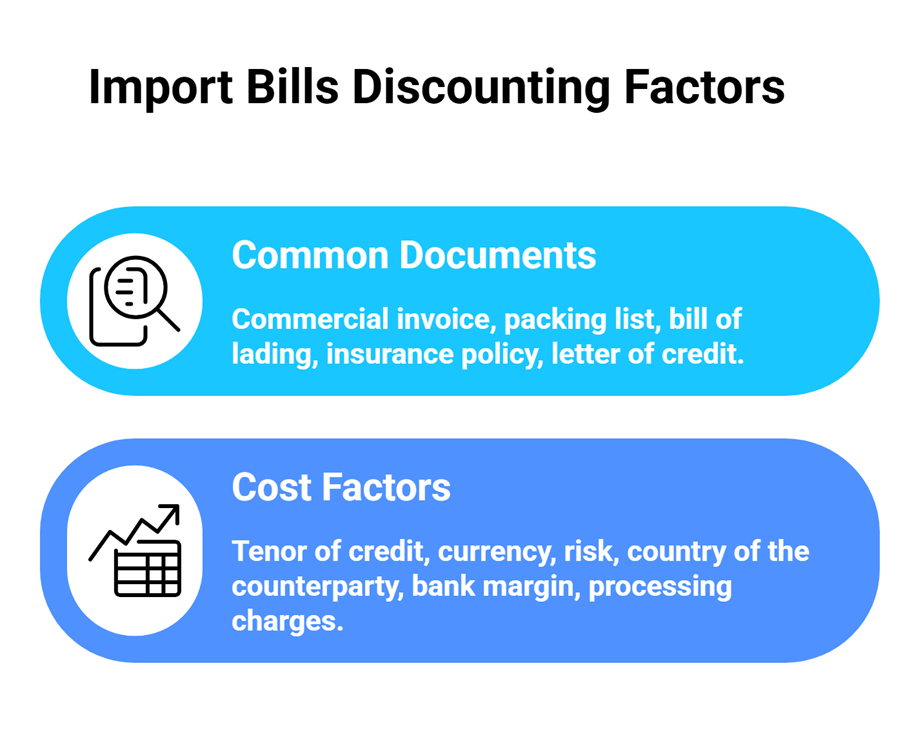
Under import bills discounting in India, common documents include:
- Commercial invoice and packing list
- Bill of lading or airway bill
- Insurance policy, if applicable
- Letter of credit or contract terms
Costs depend on:
- Tenor of credit (number of days until repayment)
- Currency, risk, and country of the counterparty
- Bank or platform margin and processing charges
When SMEs plan carefully, export and import bills discounting can support both sides of their trade cycle: incoming supplies and outgoing shipments.
Export Bill Discounting vs Bill Negotiation: Which Is Better for Your Cash Flow?
Core analytical factors
Many SMEs get confused between bill discounting vs bill negotiation. Both involve banks handling export documents and paying the exporter in advance, but there are differences in risk and structure. Under pure export bill discounting, the bank purchases or discounts the bill primarily based on the buyer’s promise to pay. Under bill negotiation, especially in letter of credit (LC) transactions, the bank negotiates documents and pays if the documents comply with LC terms.
Key strategies for foreign bill negotiation in export trade can further help businesses understand how to manage risks and improve outcomes in LC-based transactions.
Key differences to consider:
- Risk sharing: In some cases, bill discounting may be with or without recourse, while negotiation often follows LC rules.
- Documentation strictness: LC‑based negotiation is document‑heavy and strict, while some export bills discounting in India can be more flexible.
- Pricing: Charges may differ depending on risk, LC coverage, and buyer profile.
Practical choice for SMEs
When deciding on bill discounting vs bill negotiation, SMEs should look at:
- The buyer’s reliability and past payment record
- Whether the trade is LC‑backed or open account
- Their own need for speed and flexibility
In repetitive trades with trusted buyers, export bill discounting in India may be simpler and faster. In new markets, or with higher risk buyers, LC‑based bill negotiation may provide extra comfort. Both cases, export and import bills discounting help maintain cash flow, but the structure you choose should fit your risk appetite and trade model.
Using Export and Import Bills Discounting to Improve Working Capital for SMEs
Working capital finance for exporters and importers
At its core, working capital finance for exporters and importers is about filling the time gap between paying suppliers and receiving money from buyers. Export and import bills discounting directly supports this need. Instead of blocking funds in credit sales or waiting for foreign payments, SMEs convert trade documents into financing instruments.
Ways working capital finance for exporters and importers improves operations:
- Funds for raw materials and packing
- On‑time salaries and overheads
- Ability to accept larger orders without stress
- Better negotiation power with both buyers and suppliers
Common mistakes to avoid
SMEs should avoid these frequent errors when using export and import bills discounting:
- Relying on one buyer
- Over‑dependence on a single buyer increases risk if payments delay or disputes arise.
- Ignoring total cost
- Looking only at interest and ignoring processing fees, forex charges, or hidden costs can reduce margins.
- Weak documentation
- Incomplete invoices, shipment details, or contract terms can lead to delays or rejection in export bills discounting in India and import bills discounting in India.
- No cash flow forecasting
- Discounting bills without a clear repayment plan can lead to liquidity pressure later.
Modern digital platforms help reduce many of these risks by giving real‑time dashboards, document tracking, and clear pricing, making export and import bills discounting easier to manage.
Strategic Takeaways and Growmax Fintech’s Role in Trade Cash Flow
For Indian SMEs, export and import bills discounting is not just a banking product; it is a strategic tool for building stable, scalable businesses. When used thoughtfully, export bills discounting in India ensures that export receivables turn into quick cash, while import bills discounting in India allows smoother payments to suppliers without locking up every rupee. Understanding the import bill discounting process, trade risks, and the choice between bill discounting vs bill negotiation gives business owners more control over their financial future. Combined with structured working capital finance for exporters and importers, this creates a full cash flow system that supports growth, even in volatile markets.
Working capital support helps MSMEs tackle input cost pressure, making such financial strategies even more critical for sustaining operations and profitability.Growmax Fintech helps SMEs move from paper‑heavy, branch‑driven procedures to a transparent, digital approach for export and import bills discounting. With simple onboarding, document‑light workflows, and clear communication, exporters and importers can access funds faster and manage trade cycles with confidence. By partnering with a specialist platform like Growmax Fintech, Indian SMEs can focus on markets, customers, and innovation, knowing that their trade‑linked working capital has a strong and reliable backbone.
FAQ
1. What is export and import bills discounting for SMEs?
Export and import bills discounting is a way for SMEs to receive early funds against trade bills instead of waiting for buyers or suppliers to complete the payment cycle. Banks or fintech platforms advance cash based on invoices and shipping documents. For exporters, this means quick access to receivables; for importers, it means easier settlement of dues while keeping working capital stable.
2. How does export and import bills discounting help cash flow?
Export and import bills discounting converts future payments into immediate cash, which SMEs can use for production, logistics, and everyday expenses. Instead of watching money remain stuck in foreign or domestic receivables, business owners can recycle funds across multiple orders. This strengthens supplier relationships, reduces stress around long credit terms, and supports steady growth.
3. What are the key documents needed for export bills discounting in India?
For export bills discounting in India, SMEs typically need the commercial invoice, packing list, shipping bill, bill of lading or airway bill, buyer details, and sometimes contract or LC terms. Clean, accurate documents reduce processing time and the chance of queries or rejection. Digital platforms make it easier to upload and track all documents, improving the overall experience.
4. Is import bills discounting in India suitable for small businesses?
Yes, import bills discounting in India can be helpful even for smaller importers, especially those who rely on regular overseas supplies. It allows a financier to pay the supplier, while the SME repays over a defined period. This supports negotiation of better terms with suppliers, avoids shipment delays due to funding gaps, and keeps inventory flowing smoothly.